Manulua Tattoo Association - Ni, Suʻa, Manu, & Lopeti
In the spring of 2012, Manulua Tattoo Association took a trip to Tonga to provide education and awareness on safer tattooing. The trip was not without some rough spots, but the occasion truly marks a first-ever endeavor of itʻs kind in Tonga.
The association members gathered before the trip to make traditional tools and put together tattooing supplies. Our main goal was to educate Tongan tattooist on the dangers of using unclean and non-sterile equipment, and to also continue instilling the knowledge of traditional Tongan tattoo practice within the kingdom.
Traditional Tattoo Needles on Display at the
Tonga National Museum
The first couple of days in Tonga were spent tracking down members of the health ministry and making radio announcements on the free workshop that was going to be offered. The group also worked furiously to secure a place to conduct the workshop. We saw an unbelievable amount of young people with tattoos all over their body. Many were deported Tongans from abroad, but still many more were Tongans from within the country. As we asked people where they got their tattoos, the answer was most often from someone local. We even learned that there were several tattoo shops that had opened, one in Houma, and the others in town. We went by the shops but they were all unmarked and usually disguised within a barber shop or some other type of venue. There were a lot of home grown tattooists practicing out of their own residence or traveling from home to home.
Ni talking about sterilizing using a pressure cooker
In Tonga, there is a divide between the older and younger generational thinking. Many of the government officials that we ran into were trying to stamp out tattooing, and most didnʻt want to acknowledge that tattooing was as prevalent in Tonga as we had seen. Securing a place to conduct our training proved to be a challenge as many of the gate keepers to these facilities would not return our phone calls after they heard it was for a "tattoo" workshop. Otherʻs also gave us the run-around saying that we needed health clearances, documents, etc. It became very frustrating to convince these officials that we were just there to perform a free community service.
Tatatau display at the training
After finally securing a venue, we managed to talk with the Director of Health and we were offered 15-20 minutes to explain our endeavor at an HIV health conference in Nukuʻalofa. We jumped at the chance to do so as this was a great opportunity to spread our mission and vision. Initially the conference group was apprehensive to what we were doing, saying, "We are trying to stop tattooing, but you guys are here to promote it?" With some careful and insightful explanations of facts and our public health goals, the group opened up and began praising our efforts. Their buy-in was an important first step in changing the old generational stereotypes of tattooing and changing their attitudes about tattooists. They understood and endorsed our purpose and wished us success while in Tonga.
The tradtional ceiling structure at the Tonga National Centre
Ni, Suʻa and Peti checking out the equipment
On the morning of the workshop, Manulua Association and their supporters set up two tables with traditional and modern tattoo equipment. We also had a work station for clean tattoo demonstration as well as sections for break out groups. The workshop was a full day and we were surprised to have about 45-50 attendees throughout the day.
Suʻa talked about the dangers of improper tattooing techniques and the harm it can cause when the artist doesnʻt use clean equipment. Equally important, Suʻa also talked about poor aftercare and what happens to a tattoo if the wearer does not take good care of it. There were many pictures that we used to visualize what an infection looked like and what a tattoo with poor aftercare looked like. The group showed much interest in this and everyone seemed to know of someone who had an infected tattoo. Some even said that they thought it was a natural part of the healing process! It was definitely an ʻA-Haʻ moment for all of us!
After we broke for lunch, the group resumed for the second half of the training. This section was geared more for the tattooists and doing some hands on work. We had asked the tattooists in the group to bring their equipment to the afternoon portion so that we can go over safe handling and universal precautions. Each tattooists had durable tattoo machines and equipment that was brought from outside the country. However, they were reusing needles and tubes, and it was apparent that gloves werenʻt being used regularly. Many indicated that ordering supplies on a regular basis was costly and difficult. The tattooist are mostly young and have a genuine love for art and their clients. But they just didnʻt grasp how diseases can spread through reused needles, tubes and ink. One group member said that he wishes he could get gloves, but that they are very expensive and most of his clients donʻt pay him enough to afford everything that goes into safe tattooing. We realized how our Western thinking of easy access and disposing of dirty equipment was not a reality for many Tongan artists. The closest suppliers of these goods were in Australia and New Zealand. Most have to rely on overseas family to bring equipment for them because computer access and having a credit card is not commonplace.
Lopeti working with some of the artists on cleaning their equipment
AFter bringing out all their equipment, Lopeti sat down with some of the artists and had them clean their machines, wires, and other accessories. Using gloves, the artists began cleaning and Peti explained the importance of taking care of their machines. It was a profound moment to watch the artists view tattooing as a profession as opposed to the garage experience they were used to. One of the artists pointed out that he felt looked down upon by some of the professional artists that have visited Tonga because they did not have a shop or a business setting to operate. Suʻa explained to each individual his background and starting up much like them, and where he is now with his own shop and having to learn through trial and error. The group felt more at ease and a common bond was felt between us and the participants.
Lopetiʻs Tattoo Demonstration
Much of the afternoon was spent cleaning and talking. Towards the end of the day, Lopeti demonstrated on one of the participants who volunteered. The group watched earnestly as Peti set up his work station and used all the universal precautions much as they do in the shop. Group members had questions about setting the needle length, using gloves and napkins, tattooing depth, and other techniques to strengthen their own learning. There was a sense of amazement with the group as most had never seen a tattoo being applied in this way. Onlookers soon joined the group as the buzzing noise could be heard from the road. It was a culminating moment as all the learning of the day was put together to with this tattoo demonstration
Suʻa explaining tattooing depth and motifs
The end of the day was closed with complementary gift bags for each of the artists. The bags contained gloves, towels, shavers, needles and tubes, and various other items. Members were also treated to a section in which Suʻa explained machine set up and the main parts of a tattoo machine. Our efforts to do a traditional tattoo demonstration didnʻt happen during this full day session, but it turned out to be a rewarding and fulfilling day for us as well as the group participants. We each felt that we had influenced the group to think of modern tattooing as an art form that can be both professional and innovative. Group members thoroughly enjoyed the day and would soon track Suʻa down and come by to hangout and talk more about tattooing.
Our many thanks to the individuals who attended and contributed to putting this event together for us. We could not have done it without you. We are truly indebted to your love and support.
Traditional Yap Tattooing from the Island of Fais "My eyes delight in him every day,
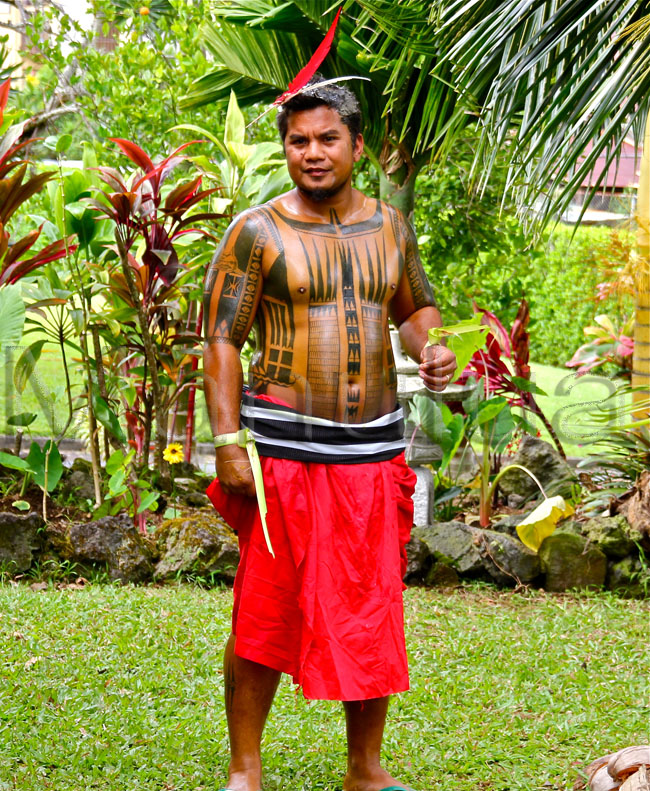
Jermy Uowolo adorning the traditional Maak Tattoo from his island of Fais, Yap.
Whenever I see him Finely tattooed all over, Dark and clear as black paint. Over it he puts a loincloth Painted flame-color with turmeric." ~ Composed in the early 1900s by a mother on Ifalik for her newly tattooed son
I was privileged to tattoo a young man from Fais, Yap. He is first to revive this tradition for his island since the last elder who wore one passed in the 1970s. Tattooing on Fais, and Yap at large fell into disuse during the 1940s - 1950s as traditional tattooist aged and passed away.
Yap is comprised of 4 main islands and 14 outlying atolls - Fais being one of the atolls. At one time, all young men and women across the islands of Yap were tattooed by their teen years. The tattooing followed strict protocols on most of the islands, and was performed by tattoo artists (known as Taupotu on Ifaluk). Women were often tattooed by their husbands as their tattooing also extended through their genitals.
Uwethog, born c. 1902, lighting up his local-grown tobacco rolled in banana leaf (photo courtesy of Don Rubinstein)
Different islands had various names for the traditional tattoo such as Yol and Maak. Different areas of the body also had separate names. There were different classes of tattoos that signified rank and birthright. The tattooing of the men most often covered the torso and back, extending down the shoulder to the elbow, and the waist to the upper thighs. The womenʻs tattooing balanced the mens tattoos in that the lower extremities were inked as well as the pubic area. The completion of a Maak on Fais was a community event with week long celebrations that culminated with the individual walking from one side of the island to the other. Their was dancing and feasting as well as ritual cleansing. The tattooed body was considered the epitome of beauty and adulthood in Yap culture.
I met Jermy and the Yap community here in Hilo through good friend, Tricia Allen. She had referred Jermy and a tattooist from Ifalik, Ike Mangi so that I can help them with reviving their tradition. Upon meeting with Jermy and Ike, I immediately saw the same drive and passion that I had for Tongan tattooing. I asked if they would agree to doing some of the work with traditional tools and allow Ike to continue some of the tattooing with machine, to which they both agreed.
Jermy, myself, and Suʻa Suluʻape ʻAisea
Our journey began in October 2011 and ended with a traditional blessing on April 21, 2012. To perform the ritual cleansing, I asked my mentor Suʻa Suluʻape ʻAisea if he would perform the ritual blessing. The blessing was a blend of Micronesian and Polynesian customs. There was lots of good food, dancing, tears, and excitement. The festivities continued through the night with kava drinking and betel nut chewing.
Theirs a common thread that binds all of us in the Pacific. This thread unravels to produce the multiplicity of Oceanic cultures, but is still attached to the common root which holds our kinship. Having known nothing about the Yap culture or where Fais was, I was surprised to learn the unquestionable distant link between Tonga and Fais. Tonga was brought out of the depths of the ocean by Maui Kisikisi (also known as Maui Tikitiki). Fais was also brought out of the depths of the ocean by Motiktik. The use of Tumeric and oils as a medicinal aid in healing, cleansing, and protection. Yap traditional stick dance mirrors a traditional Tongan stick dance called the Soke (click on the links below).
Many other similarities with foods, forms of respect, social hierarchy, and customs were undoubtedly related. In learning our own revived traditions, Iʻve gained a deeper respect for all traditional cultures striving to maintain their identity in the evolving global culture of the modernization. Thank you to the Uowolo family for allowing me to be part of your rich heritage and for welcoming me into your community. Thank you also to Suʻa and my Tongan brothers and sisters who supported this historical moment.
2011 was a year filled with many new and exciting changes. Aisea was invited to Tonga to present tatatau in the kingdom for the first time in over a 150 years. We also held tool making workshops in Hilo, Hawaiʻi, and crafted some traditional implements for myself and Lopeti.
We started the weekend by getting straight to work. We made 6 sets of tools with needles and fiberglass backing, and 3 sets with turtle shell and boars tusk. After picking up some tools from the local hardware store, we started by crafting the hau. Peti and I slowly cut each hau to size and shaped each notch for piecing together each tool. The tool is made up of 4 basic elements: the handle (Hau tā), the plate (Tuʻa), the teeth (Nifo), and the lashing medium (Kafa).
In the modern set, fiberglass and sautered metal needles are used. This is the chosen method of modern times since it is easily sterilized and maintained. However, in keeping with tradition and the process of learning, a traditional set was also made using
turtle shell and boars tusk. I found these harder to make as the materials were much more delicate, and required more work using natural tools like sea urchin quills.
As the tools were being made, stories were also being shared about tattooing history. Several Micronesian individuals who also came to help shared some stories from their islands. We found many similarities and shared connections
not only through tattooing, but migrational voyages, deities, and cultural practices. We also talked a lot about how the introduction of borders and artificial classifications (i.e., Polynesian, Micronesia, etc.) have prevented islanders from continuing long standing relationship with each other. These classifications as well as territorial affiliations with Western countries have created a disconnect in sea voyaging traditions of the past. Maui, the great demigod of much of Polynesia is also found throughout Micronesia, as well as the use of turmeric and oil for sanctifying and protecting the body.
The close of the first night was around the kava bowl. Vinette made a brew using fau, a native hibiscus, to strain the kava. The similarities with Tongan traditions of mixing kava were welcoming. During a kava circle, Tongans will use strands of the fau to strain the kava and pour it. In Micronesia, the fau is used to strain but to also flavor the kava with itʻs natural liquid and coat it for easier drinking. We can all attest that the grog did make us feel very relaxed after a full day of work!
The second day continued with fine-tuning the boned teeth and preparing the fiberglass plates. Each bone had to be cut to a certain size. The piece of bone was then filed down into a fine plate no thicker than a
credit card. The bone was very delicate and any incongruities or deformities may render the plate unusable. The fiberglass backing was also a challenge as the backing had to also be filed down into a tapered end which would make it easier to attach the bone plate onto a smooth surface. I realized that the art of making tools was just as impressive as the art the tool will eventually deliver. Each tool had to be finely scrutinized by Suʻa Suluʻape ʻAisea so that we could learn what the imperfections were. ʻAiseaʻs attention to detail is unquestionable. The tool has to be able to be used without the artist worrying about things falling apart or coming undone.
Day two continued to be a day of learning for me. We talked a lot about the construction of the traditional Tongan tattoo. Sitting with Lopeti, ʻAisea mapped out the construction of the lomipeau, tanoʻa, kafa and ngafingafi and tuku. We also discussed navigation and how traditional toutai used to navigate the oceans without the aid of GPS. These are all included in the construction of the tattoo. The amonga, a symbol of balance and also a guiding star to Tonga is affixed into the center of the back.
We also discussed the ancient Tongan religion and the designation of Pulotu, Lolofonua, and Langi to the Tongan trinity: Havea Hikuleʻo, Kau Maui, and Kau Tangaloa. Elements comprising these three and their societal roles make up the tulī, maʻala, and ʻilaheva patterns. We all gained a deeper appreciation for the art and traditions through understanding itʻs historical and modern place in Tonga.
Day three was the final day in which we bound all our tools together and prepared them for use. Lopeti and I spend most of the day making our needled teeth. This was much harder than I
thought because of the precision needed to make each needle line up. We began by making our larger teeth set, the Haupulu, down to our smallest set, Haumono. We finished up the night by doing some work/practice time on Francis. His tattoo was partially completed by me earlier this year, and he volunteered to have us practice our new tools on him. Heʻs a true sport!
Suʻa instructed on the depth and strength to applying the tattoo, as well as how to hold the tool properly to ensure repetitive lines. Lopeti and I set up and took turns tattooing. Sherwin also helped stretch as we slowly applied new patterns and touched up on older lines. The night was very productive and educational, and the weekend was was definitely a growing experience!
Another weekend workshop will be planned, but timing is probably the most difficult thing to coordinate. Suʻa has his business and travels, which limits his travel time for teaching. His goal however is to spread the knowledge of traditional tattooing to those willing to learn. Respect for the cultures that carry on these traditions is vital to learning; and understanding the histories which have held island people close to their past is fundamental to beginning the journey.
In 2010, Su'a Sulu'ape Aisea Toetu'u was invited to display and practice tatatau in Tonga for the first time in over 150 years. The Kava Kuo Heka festival on cultural diversity is held every year as a means of informing and keeping Tongan traditions in the forefront of global changes. Aisea was able to tatatau on several individuals and stirred the interest of Tongans. The following is the preface I wrote for Aisea's part of the workshop. Thank you to Katalina Lobendahn for the Tongan translation and to Latai Taumoepeau for the pictures.
Traditional Tongan tattooing practice was once a common part of Tongan culture. Every young male would be tattooed by the time he reached adulthood. Tattooing among Tongan women was just as common and decorative. Tongan tufunga tatatau were widespread throughout the islands of Tongatapu, Eua, Ha’apai, Vava’u and the Niua’s. George Tupou I outlawed traditional tattooing in 1839 in effort to Christianize the country and bring all the islands under one kingdom. Despite being a devout Christian convert, George Tupou I was also tattooed traditionally by a Samoan tufuga.
Abandoned for over 150 years, traditional tatatau is now undergoing a resurgence with help from Samoan master tattooist, Su’a Suluape Petelo. Traditionally, the Su’a family were responsible for tattooing Tongan ‘eiki like the Tu’i Kanokupolu. Since 2003, a handful of Tongan individuals have been traditionally tattooed and are the first to wear a tongan tatatau in over 100 years. In 2007, the title of Su’a Suluape was bestowed on a Tongan, Aisea Toetu’u. Aisea is the first Tongan tufunga tatatau to have completed traditional work on another Tongan and under this honored title.
The Tongan word ‘Vaka’ has become symbolic in representing this revived tradition. It has also been adopted as the name for the traditional tatatau. As the saying goes, “Toki tau ‘a e vaka e”—so too has this vaka arrived on Tongan shores where it can now seek refuge and reawaken our Tongan tradition.
*********
Mei ono’aho, ne hange ha me’a noa, pe koe me’a anga fa’a fai ‘a e tatatau ‘i Tongani. Pea koe meimei talavou kotoa pe ‘i he kuohili ne tatatau’i kinautolu te’eki ke nau hoko ‘o tangata lahi. Ne kau ai mo hono tatatau’i ‘a e kau finemui moe kau fefine honau sino koe fakateuteu. ‘I he ngaahi taimi koia ne tokolahi ‘a e ha’a Tufunga Tatatau ‘i Tongatapu, ‘Eua, Ha’apai, Vava’u pehe foki ki he ‘otu Niua.
‘I hono feinga’i ke fakatahataha’i ‘a e ‘otu Tonga ke hoko koe pule’anga pe ‘e taha mo hono liliu’i pe fakalotu’i ‘a e kainanga e fonua ke tafoki ki he lotu faka Kalisitiane, ne hanga ‘e he ‘Uluaki Fa ‘o fakatapu’i ‘i he 1839 ‘a e anga fakafonua koeni koe tatatau. Pea neongo hono fakatapu’i ‘e Tupou I ‘a e tatatau ‘i he ‘otu motu Tonga ko ‘ene mateaki’i ‘a e lotu faka Kalisitiane; ka ‘i he ‘ene kei talavou, ne tatatau’i ‘e he Tufunga Tatatau mei Ha’amoa ‘a e La’a koia kuo unga fonua.
Talu e li’ekina ‘a e tatatau mei Tongani ‘i he ta’u eni ‘e teau nimangofulu tupu, kuo ake ‘i onopooni ‘a e tatatau ‘i he kainga Tonga; pea ‘oku fakamalo ki he tokoni moe ngaue ola ‘a e ‘Eiki Tufunga Tatatau mei Ha’amoa ko Su’a Suluap e Petelo hono fakaake ‘a e konga mahu’inga koeni ‘o ‘etau hisitolia. Koe tukufakaholo ‘o e famili Su’a, ko ‘enau ngafa pe fatongia ke tatatau ‘a e Ha’a Tu’i Kanokupolu. ‘I he 2003 ‘i Vaihi (Hawai’i) ne tu’u mai e to’utangata ‘e toko nima ke tatatau’i kinautolu ‘o hange koe anga fai mei ono’aho, pea ko kinautolu eni ‘a e fuofua tangata Tonga kuo ‘aofi honau sino ‘aki ‘a e tatatau Tonga talu eni e ta’u ‘e teau tupu. ‘I he 2007, ne hanga ‘e Su’a Suluape Petelo ‘o fakanofo ‘a e tangata Tonga ko ‘Aisea Toetu’u ki he hingoa Suluape, pea ‘oku ‘iloa e ‘uluaki Tufunga Tatatau Tonga koeni ko Suluape ‘Aisea Toetu’u, pea kuo fakakakato ‘e he tangatani ‘a e fatongia tatatau angamu’a ke tatatau’i ha Tonga ‘aki ‘a e hingoa fakalangilangi koeni.
Koe lea Tonga koee koe “Vaka” ‘oku fakatatau pe fakafofonga’i ke
fakamo’ui ‘a e anga fakafonua koeni koe tatatau. Pea kuo ngaue’aki ‘a ehingoa koeni ki he ngaue mahu’inga fakafonua koeni. Hange koe lea ‘oku pehe, “Toki tau ‘a e vaka e” – pea koeni kuo foki ki ‘api ‘o taulanga e vakani ‘i Tongani ke hufanga pea fakaake ai ‘etau anga Faka‐Tonga koeni.
I've had a number of requests about women's tattooing tradition in Tonga. I've been researching and looking through old books trying to gather as much info on the subject.
So let's start with the basics. Women were tattooed in Tonga before the entire practice of tattooing was outlawed. The extent of tattooing women in Tonga is not known entirely because not much was ever written. But here's what is known:
Women often received ornamental tattoos around their fingers, hands, and wrists. These were often done for aesthetics and for helping to cure ailments such as types of arthritis and other joint pains.
Women were also known to receive markings along their shoulder area and across the lower back. These were also decorative and some sketches resembled strands of maile and other kakala fakatonga or Tongan plants that represented the ultimate forms of beauty.
Anecdotally, my mother told me a story of a woman in Tonga named Mele Tatafu who had an extensive tattoo across her back. As told by my mom, she was hanging laundry with Mele one day when her tupenu slipped revealing a large and intricate tattoo that covered her back and extending further down towards her butt. My mom being young couldn't recall the designs but also sensed that Mele was not wanting to talk about it. From my mom's vague recollection, she said that it was very intricate with many block like prints and makohikohi or scratch like patterns.
I will be writing more on this subject soon as I look through and compile more info. If you have your own stories and want to share, please feel free to share them and I will post it.
The word "Tribal" has been used to describe island tattoos that are now in fashion. When referring to a Tongan or Samoan or most other Pacific Island tattoos, the word "Tribal" is incorrect. Referring to Islanders as living in 'tribes' is a racist notion used to separate people according to how civilized they are.
Tongans never lived in tribes and their tattooing practices weren't practiced within a tribal context, so do not refer to them as "tribal tattoos".
Tonga has undergone several major social changes over the last millennium, which created a complex system of social and family ranking. Prior to the adoption of Western law and government, Tongan society was stratified into 3 classes: Eiki, Tu'a, and Hopoate (High chiefs/Gods, Commoners, and Slaves).
The Tu'i Tonga
The highest ranking and oldest chiefly title in Tonga belongs to the Tu'i Tonga. The Tu'i Tonga line began around 950AD with the last Tu'i Tonga title being bestowed on Laufilitonga in the 1800's. The Tu'i Tonga line was eventually folded in with the current ruling dynasty by Taufa'ahau Tupou I and later consolidated by the late Queen Salote through her marriage to Tungi Mailefihi.
The first Tu'i Tonga was 'Aho'eitu, who was the son of Tangaloa'eitumatupu'a and Va'epopua. He created and instituted this sacred line which eventually led to the creation of two subsequent dynasties--the Tu'i Ha'atakalaua and the Tu'i Kanokupolu. These dynasties would control the direct authority over Tonga, rendering the Tu'i Tonga as toputapu - sacred and deified. This meant that no Tongan was allowed to touch or look upon the Tu'i Tonga unless he/she had divine responsibilities to this chiefly line. This sacred divinity meant that those belonging to the Tu'i Tonga line were tattooed on rare, significant occasions. For the most part, they were never tattooed. Several accounts detail Tu'i Tonga that were tattooed:
During the 1800s, Tonga was undergoing radical changes, both in power and culture. This was largely due to the growing Kanokupolu dynasty and Christianity. The Tu'i Tonga, Fatafehi Fuanunuiava, vowed to break custom in rebellion against chiefs who were dismantling the Tu'i Tonga's power. In his rebellion, he broke the tapu on his body and got a Malofie. The process was completed in Samoa in two sessions, which gave him the nickname "Fakauakimanuka" commemorating the completion of his tatatau within the two journeys. The first trip was to Manono to begin the process. The second and final journey was to Manu'a where the tattoo was finally completed. On both occasions, the tattooers' bodies were said to have swollen up. Eventually, both died as a result of 'wounding' the Tu'i Tonga's sacred body. Upon completion of the tatatau, two 'ie toga (Samoan fine mats) were given to Fatafehi to commemorate the event and as a gesture of respect to the Tu'i Tonga high sacred rank.
Fakana'ana'a was the 34th Tu'i Tonga. It is said that he was tattooed on the island of Mo'ungaone in Ha'apai using unconventional tattooing methods of the time.
The Tu'i Ha'atakalaua For a short period, the Tu'i Ha'atakalaua was created, and the position of Hau - a chief who directed the affairs of governing his people - was created. The Tu'i Tonga title at this point became less involved with the direct affairs of governing, and the 'inasi, or honoring/offerings of first harvest, became a ritual part of honoring the Tu'i Tonga legacy. The Tu'i Ha'atakalaua followed much of the traditions of the Tu'i Tonga and were not tattooed as well.
The Tu'i Kanokupolu The Tu'i Kanokupolu title became the more dominant and powerful title during the 1500s and eventually overshadowed the direct authority of the Tu'i Ha'atakalaua. The first Tu'i Kanokupolu was Ngata who was born from the ruling Tu'i Ha'atakalaua and Samoan mother named Limapo (known also by her Tongan name, Tohu'ia). In keeping with the Samoan traditions of its maternal heritage, the Tu'i Kanokupolu instituted the malofie as a mark of chiefly status, and perpetuated the traditions of being tattooed only by a Samoan Tufuga. This was also a gesture to connect with his mother's Upolu heritage.
Mata'eleha'amea was the 4th Tu'i Kanokupolu. It is said that when he received his malofie, his backside was untattooed which earned him the nickname Mata'ele'usitea.
Taufa'ahau Tupou I went to Samoa and completed a full malofie in one day. He also had the tip of his penis tattooed completely black to show his ability to withstand pain.
Chief Vaha'i also wore a Malofie that was completed by a Samoan tufuga tatatau.
Throughout this change in power amongst the chiefly families in Tonga, commoners were continuing the tattoo traditions which had been practiced from long before. It was not till traditional tattooing was completely outlawed in 1839 that Tongans finally began abandoning this longstanding practice. Tongans chiefs and commoners who wanted a tattoo would soon have to travel to Samoa to have one completed. Ultimately, Savai'i tattooing families gained much from this new law as many were paid with fine mats, ngatu, and other forms of cultural payment for the tattoo received.
In traditional Tongan society, there were professional classes of skilled men and women who held different societal roles. These roles could be hereditary or not. Collectively the were known as Ha'a Tufunga or a class of skilled professionals. Some hereditary roles for men included:
Tufunga Fou Vaka: Canoe builders for long or short sea voyages
Tufunga Fono Lei: Makers of whale-tooth body ornaments
Tufunga Nima Tapu: Overseers of funeral rites ensuring proper burial protocols were followed
Tufunga Ta Maka: Stone masons or stone vault makers
Tufunga Sia Kupenga: Net makers for fishing and other sea expeditions
Tufunga Toutai: Skilled Tongan fishermen who had a vast knowledge of the ocean, tides, sea life, and the sky
Tufunga Langa Fale: Those who were skilled in constructing large social and spiritual houses
Tufunga Lalava: Individuals trained in traditional lashing of houses
Other social roles could be hereditary or not:
Tufunga Tongi Akau: Carvers of traditional war clubs and engraving
Tufunga Tele Kava: Barbers or shavers who used shell for shaving
Tufunga Tatatau: Men who performed the art of traditional tattooing
Additionally there were specialized societal roles that governed the physical and metaphysical:
Kau Faito'o: Male and Female individuals skilled in traditional healing, massage, and curing other body ailments
Kau Taula: Traditional male or female spiritual priests of the old religion who served as vessels between the seen and unseen world
The list goes on describing various professions that made up the Tongan material/social culture. However, what we will focus on is the Tufunga Tatatau role and it's importance. Unlike Samoa where there were specific families that held divine rites to tatatau, Tonga, on the other hand did not maintain this criteria for tufunga tatatau. A tufunga tatatau was usually a very skilled artist and had learned from another tufunga tatatau - whether blood related or not. Tufunga tatatau were known throughout the various islands that now make up the Kingdom of Tonga: Ha'apai, Vava'u, Eua, Tongatapu, etc.
Despite Tonga and Samoa sharing many similarities, there were distinct differences in tattooing traditions between the two cultures. In Samoa, the Malofie was considered the ultimate mark of social rank and obligation to the family and community. In Tonga, tatatau did not take on such heavy societal obligations. However, Tongan social structure at the time dictated tattooing practices for the different social classes. For example:
1) High chiefs of the Tu'i Kanokupolu line were tattooed by a Samoan tufuga due to Tongan customs of tapu and a lineage that stems from Samoa.
2) Priests, or Taula, tattooed specific patterns on designated parts of their body as a means for honoring a deity sacred to a village or family. One example were taula's that tattooed Veka or Kalae or Tavake patterns on their throats and hands.
3) A tatatau of Samoan origin was considered more esteemed than one completed by a Tongan tufunga. This was largely due to the origins of chiefly lineages in Tonga connecting to Manu'a and Upolu; and because of a divine birthright bestowed on certain Samoan tattoo families like Su'a.
A different way of looking at it would be to classify Tatatau into two realms:
1) 'Eiki: These who were chiefs of divine birth, direct descendants of the Tu'i Tonga line. These individuals were considered so sacred that they were never tattooed because their body was untouchable by anyone (Tapu).
There were also chiefs who fell into this category considered lesser chiefs, but were still of divine descent. These were the Tu'ikanokupolu chiefs who trace their origins from 'Upolu in Samoa. They brought with them and institutionalized the Malofie as a part of Tongan culture and their reign. The only people allowed to tattoo them were member's of the Su'a Suluape family. These chiefs were reserved exclusive rights to these tattoos to set them apart from commoners. At times championed warriors would also be bestowed with a Malofie to distinguish their mana and favor.
2) Tu'a: The rest of Tongan society was made up of commoners who were of no direct chiefly blood lines. They were tattooed by tufunga tatatau who lived in Tonga and abroad. These tattoos were similar to the Malofie but also had common ties to tattooing elsewhere in the Pacific such as Tokelau, Uvea, Rotuma, etc. These tattoos varied in size and structure and were mostly clothed on warriors and those who could afford them. Priests and women also tattooed themselves on various parts of their body for adornment, religious, and medical reasons.
For most Tongan commoners, getting a tatatau had a lot to do with personal choice. Tongan tattooing was practiced more for aesthetics and social acceptance. George Vason, one of the few missionaries to get a tatatau, explained that he was teased by Tongan men and ridiculed for not having one. A man who was not tattooed was considered 'naked' and undesirable by Tongan standards. It was just as much as symbol of masculinity as it was a division between boyhood and manhood. Tattooing was very common throughout the Tongan kingdom. It was not considered a sacred practice reserved only for high ranking chiefs as it was in Samoa.
Traditionally a person desiring a tatatau would discuss with the tufunga designs and meanings that were to be later etched on skin. Ultimately, it was the tufunga, with his knowledge of tatatau, that would decide on the overall placement and look of the tatatau according to standard protocols. The process could take months to complete and compensation came in the form of food and other cultural goods. Tufunga tatatau fashioned their tools according to traditional methods shared by most pacific islanders.
Several combs and tattooing implements were collected by Europeans during their voyages through Tonga. Some have been preserved in museums, but most have disintegrated with time. There were different size and types of combs with various names. Most often the names of each style/type of comb was descriptive of it's function.
I just needed to clear this up with today's blog since several people have written me regarding this issue. It is obvious that they did NOT read the blogs because I do not say anywhere that tongans invented traditional tattooing.
Just to clear things up AGAIN. Samoa is the only recognized island in the Polynesian island group to have continued traditional tattooing to the present day. There are tufuga tatau families in Upolu that have passed on the tradition from generation to generation. Although tattooing is outlawed in Samoa, it is still practiced with moderate interference by the law.
Tonga once practiced traditional tattooing, but it was outlawed in 1839 by the Tongan government because it was considered unnatural in the Christian world. Despite the outlawing of tatatau in Tonga, Tongan chiefs would still travel to Samoa (as they had done for centuries) to get tattooed by one of the tufuga tatau.
The other issue that has come up is "who was first to practice tattooing". The answer - "I don't know?" But if you want to believe that Samoans were the first, then so be it. If you understand that culture and traditions are handed down from generation to generation, then the beginning of tattooing predates beyond Samoa to earlier cultures beyond the Pacific. Tattooing has been around for thousands of years. Egyptians tattooed, Indians also tattooed their bodies; early Europeans had extensive tattoos across their body. Tattooing is not a Polynesian/Pacific Island invention. Samoa has their own unique tattoo tradition that has developed over hundreds of years to become uniquely identifiable as Samoan. But the same holds true for other Pacific Islands. So to say that Samoa or Tonga was first to tattoo or develop Pacific Island tattooing is basically meaningless to what this blog is about. I am just trying to spread the knowledge that Tonga had a tattoo tradition that is now non-existant. A revival of this knowledge is ongoing, but it will never supersede Samoan traditional tattooing. Please understand that this is not my intention and Tongans would NEVER say that tattooing is a Tongan invention. It is understood by every Tongan that tatau is a unique identity of being Samoan. Enough with the rivalry between who's better than who. I do not live in that world, so keep it out of mine.
Prior to receiving my tatatau by Su'a Suluape Petelo, I was fortunate to sit and talk with him about his practice, and also participate in an exchange of knowledge. The following were things that he conveyed during conversations in 2002 and 2003 about the traditional Samoan Malofie.
Malofie is the true Samoan terminology for a traditional Samoan tatau. It was never called a pe'a until recent times; around the 1800s anthropologists and other researchers began to ask questions about it and according to Suluape, it was then that men wearing the pe'a started referring to it as a pe'a. In actuality, the pe'a is a very small pattern that is tattooed on the lower part of the back, right about the tailbone area. Pe'a patterns symbolize the fruit bat of Samoa. He wasn't sure how this word became the predominant word for Malofie. There was also the notion that a man with a completed Malofie resembled a pe'a with it's wings closed - the head being the male genitals. To this day, pe'a remains the common term associated with a traditional Samoan tattoo.
Pekadoes not translate as easy into Tongan as pe'a does in Samoan. Because Samoans have been using the word pe'a to refer to their tattoo(s), it is generally accepted and non-offensive. However, to refer to something or someone as peka in Tongan can be misconstrued as derogatory, and hence, may cause much offense to Tongans. The indigenous Tongan word for tattoos and tattooing is Tatatau.
Tattooing tools are truly sacred and are passed on to an apprentice by the tufuga when the tufuga deems it appropriate. The apprentice must serve the tufuga at every moment and absorb everything that is spoken by the tufuga before he is deemed worthy to receive his own tools. This includes understanding the stories that accompany the tattooing, the specific construction of the tattoo, and how to each session is devised according to longstanding traditions. This also includes understanding the techniques of using the Au and Sausau (the traditional tattoo comb tool and tapping stick - called Hau and Hahau/Sausau in Tongan) and the science of stretching the skin when tattooing - toho kili or fusi kili.
Once given the tools, the apprentice is bestowed the Suluape title, and is required to perform a certain number of tattoos and remain in the service of the tufuga as an au koso (stretcher). He is also to understand how to conduct preparations for the ceremonial blessing or sama. Once the apprentice has completed a set number of tattoos and is able to construct and care for his own tools, he will then be bestowed the title of Su'a. Once a Su'a, he is then able to carry on tattooing and will begin carrying out the sacred sama ritual with each individuals he completes. This is overseen by the tufuga for a time until the apprentice is found able to fully carry out the tufuga tatau traditions solely. With the advent of Westernized individualism and a culture of instant gratification, there have been some Samoan and other Pacific Island individuals who have attempted to bypass the above tradition and construct their own tools and tattoo without a cultural license to practice. Many of these tattooists are untrained, untitled, and unaware of the damage they may be causing to individuals who are attempting to reconnect with their culture.
There are individuals out there walking around with traditional tattoos that are crooked, poorly constructed, and strange looking with incorrect design placement. Furthermore, many of these tattooed individuals did not undergo proper preparations before the tattoo, nor did a receive a proper blessing after.
If you come across a traditional tattoo artist, it is important to find out who their teacher was, how long they apprenticed for and where did they get the tools from. This might offend the tattooist so sometimes relying on gut instincts is probably the best defense against these self-proclaimed tufuga.
Each person tattooed by a student of the Su'a Suluape clan also recieves the traditional family signature which occurs as the final marks on the body. These markings are very distinct to the this clan and anyone tattooed by the Su'a Suluape clan will recognize this mark when seen on another person. This is another way to ensure the tattooist autheticity. From my last conversation wtih Su'a Suluape Petelo, he had only bestowed the Suluape title on 5 individuals, and the Su'a Suluape title on 3 individuals. This is important considering the amount of "traditional" tattoo artists that are growing in numbers in America, New Zealand, Samoa, and Australia.
What's the Big Deal? Many have asked this as well. I hear comments like "we don't live in Samoa so why do we need to go through all that tradition crap?" In order to preserve the true integrity of wearing a traditional tattoo, you must respect the traditions that have held it together for hundreds of years. Naturally, the malofie has evolved from pre-western days as a result of each tattoo family; however, many modern day tattooists (both Islanders and non-Islanders) have taken it upon themselves to 'revolutionize' this sacred practice, turning it into a fad and popularity contest for the artist's own selfish recognition. This was never the intent of wearing a traditional tattoo. As Suluape tattooed individuals, he would remind them of their duty to take care of their family, being responsible to cultural tradtions, and knowing that you represent more than just yourself by wearing the malofie.
Many people have written me criticisms and accusations that I'm making up everything on the site. Please read the "Historical Observations" page which cites pretty much anything that was written about Tongan tattoos within the last 500 years. And if you still don't believe it, go look up those sources yourself and make your own conclusions. It's a little hard to dispute accounts written hundreds of years ago by observers who had no reason to make up stories about what they saw.
Here are some facts about the tatatau:
Tatatau is made up of two Tongan words, Ta (to strike) and Tatau (similar, repeated); literally 'to strike repeatedly' such as a tufunga tatatau would do with the hau as he 'tapped' the tattoo onto a person. The word tatau has different meanings in other Pacific Island languages, and may differ greatly from the Tongan meaning. However, tatau is a word that used in everyday Tongan speech to refer to something that is the same or similar, e.g., 'Ai pe ke sipinga tatau - Just make the patterns the same. In its poetic or aesthetic form, ta also refers to time or a status of time, and tatau can invoke a sense of complete symmetry or both sides being equal inside and out. In this thought, tatatau could also be interpreted as the state of complete balance in all things.
Tufungawas a person skilled in a particular Tongan craft or material profession. Tufunga also referred to material arts manufactured mostly by men as opposed to nimamea'a which were fine arts mostly made by women. These professions could be hereditary or non hereditary. In Tongan, the word Tufunga does not take on the same intensity as it does in other islands like Samoa (Tufuga), Aotearoa (Tohunga), Marquesas (Tohu'a) or Hawai'i (Kahuna). The word tufunga simply designates a professional, societal role. For instance, there were:
Tufunga Toutai ika - skilled Tongan fishermen;
Tufunga Ta Maka - makers of stone vaults for the burial of chiefs;
Tufunga Fo'u Vaka - canoe builders;
Tufunga Ta Tatau - traditional tattooists, and so on.
Tufunga were the fabric of Tongan society, artisans that created the material Tongan identity through their skills.
1839was the year that King Siaosi Tupou I began devising laws that would eventually outlaw and eradicate traditional Tongan tattooing. After his conversion to Christianity, many traditional practices that were not favored by Christian values were deemed unnecessary, heathenistic, or pagan; even though he himself had been tattooed in the traditional manner. Though the practice of tatatau quickly vanished in Tonga, Tongan chiefs, especially those of the Kanokupolu line, continued to travel to Upolu and Savai'i to get tattooed. Samoa had not abandoned the practice, and Tongan chiefs, because of their status, still felt somewhat exempt by the new laws/codes that now governed regular Tongan society.
Besides traditional tattooing, other cultural practices soon disappeared such as:
Po me'e - celebrations that culminated in open sexual encounters;
Tutu'u nima - the act of cutting off a finger after a ranking individual had passed away;
Tumomosi - burning beauty marks on the body with pieces of rolled ngatu;
Fangatua - social boxing and wrestling tournaments performed by men and women.
The knowledge of these traditions barely exist today as they have either been outlawed for over a hundred years, or the practice simply stopped all together because they had no more signficance to Tongan people.
So how come Samoa was able to keep traditional tattooing alive and Tonga wasn't?
First let’s make it clear that both Tongan and Samoan cultures have lost many of their old traditions, but other traditions remain intact much is as it was in pre-Christian times. It's not so much a matter of which island is more traditional, but rather, what we can learn from each other to rekindle our lost traditions.
After a long period of civil war and infighting amongst ruling chiefs of Tongatapu, Eua, Ha'apai, Vava'u, and Niua were united under one national Monarchy in the 1800's, it became easy to control the infrastructure of Tongan society with laws that were enforced by district high chiefs and lower ranking village chiefs. These chiefs had hereditary ties to the ruling Monarch and were obligated both by rule and by deeply embedded Tongan values of service to the king (mateaki). These island groups were nationalized and established as a country under the name "Tonga". The work of missionaries to convert chiefs continued, subsequently converting the people of the new kingdom to Christianity. With the new reformed central government, Tongans adapted to suit the desires of the new Christian Monarchy and Christian values.
Samoa, on the other hand was never a unified country under one ruling dynasty since the Tui Manu’a reign prior to 900AD. Each village had a high chief that governed the people who lived within the village. Each village adapted to the introduction of Christianity and westernized ideas according to the desires of their chief(s). This made it hard for Christian missionaries to enforce widespread laws across all of Samoa. Each village ultimately shaped the new changes for themselves rather than it be governed by a singular lawmaker.
Ultimately, foreign imperialist powers intervened, and Britain and the US divided Samoa into two separate nations (Western Samoa [now independent Samoa], and American Samoa). Work ensued with various village chiefs to create a westernized, central government for each nation. By this time, Christianity had been adopted as the common religion of each village, but because high chiefs still maintained control, various cultural practices (such as tattooing) remained strong in certain villages, while in other villages they were no longer practiced or had evolved with the new Christian religion. By the 1900's, traditional tattooing was only practiced by several tufuga tatau families in Western Samoa, and became restricted to the sons of village chiefs rather than a rite of passage for every Samoan boy entering into manhood.
As cultures adapted to westernization and modernization, stories, values, and knowledge soon disappears from the framework of that society. This inevitably continues to the present day in the Pacific. It is a gradual process that fades with each generation. If it reaches the point of extinction, it then becomes easy for us to question if it really existed at all?
In 1999 I was fortunate to spend 2 weeks on Rapa Nui. I was amazed at the enormous Moai statues that were carved and spread out across the island's landscape. However, the Rapa Nui people had no recollection of how these were made, why some of them were made, and how they moved these huge megaliths across the island. One of these alter of statues (ahu) was called Tongariki, which an elder explained to me was built by a chief from Tonga. The Rapa Nui also had a written hieroglyphic language called Rongorongo which is no longer understood by its people. Even though the statues and the tablets of rongorongo still physically exist, all knowledge of these two distinct traditions has completely disappeared. This is where Tonga is at with the tatatau. Many Tongans and non-Tongans now question whether it really existed despite documented proof and plain old common sense. As we now enter an era of globalization, what traditions will no longer exist in a hundred years? It becomes ever more important to utilize modern mediums such as the internet to promote and perpetuate anything and everything that is Tongan for future generations.




 2011 was a year filled with many new and exciting changes. Aisea was invited to Tonga to present tatatau in the kingdom for the first time in over a 150 years. We also held tool making workshops in Hilo, Hawaiʻi, and crafted some traditional implements for myself and Lopeti.

 not only through tattooing, but migrational voyages, deities, and cultural practices. We also talked a lot about how the introduction of borders and artificial classifications (i.e., Polynesian, Micronesia, etc.) have prevented islanders from continuing long standing relationship with each other. These classifications as well as territorial affiliations with Western countries have created a disconnect in sea voyaging traditions of the past. Maui, the great demigod of much of Polynesia is also found throughout Micronesia, as well as the use of turmeric and oil for sanctifying and protecting the body.


 Another weekend workshop will be planned, but timing is probably the most difficult thing to coordinate. Suʻa has his business and travels, which limits his travel time for teaching. His goal however is to spread the knowledge of traditional tattooing to those willing to learn. Respect for the cultures that carry on these traditions is vital to learning; and understanding the histories which have held island people close to their past is fundamental to beginning the journey.


