Traditional Yap Tattooing from the Island of Fais
"My eyes delight in him every day,
Whenever I see him
Finely tattooed all over,
Dark and clear as black paint.
Over it he puts a loincloth
Painted flame-color with turmeric."
~ Composed in the early 1900s by a mother on Ifalik for her newly tattooed son
I was privileged to tattoo a young man from Fais, Yap. He is first to revive this tradition for his island since the last elder who wore one passed in the 1970s. Tattooing on Fais, and Yap at large fell into disuse during the 1940s - 1950s as traditional tattooist aged and passed away.
Yap is comprised of 4 main islands and 14 outlying atolls - Fais being one of the atolls. At one time, all young men and women across the islands of Yap were tattooed by their teen years. The tattooing followed strict protocols on most of the islands, and was performed by tattoo artists (known as Taupotu on Ifaluk). Women were often tattooed by their husbands as their tattooing also extended through their genitals.
Different islands had various names for the traditional tattoo such as Yol and Maak. Different areas of the body also had separate names. There were different classes of tattoos that signified rank and birthright. The tattooing of the men most often covered the torso and back, extending down the shoulder to the elbow, and the waist to the upper thighs. The womenʻs tattooing balanced the mens tattoos in that the lower extremities were inked as well as the pubic area. The completion of a Maak on Fais was a community event with week long celebrations that culminated with the individual walking from one side of the island to the other. Their was dancing and feasting as well as ritual cleansing. The tattooed body was considered the epitome of beauty and adulthood in Yap culture.
I met Jermy and the Yap community here in Hilo through good friend, Tricia Allen. She had referred Jermy and a tattooist from Ifalik, Ike Mangi so that I can help them with reviving their tradition. Upon meeting with Jermy and Ike, I immediately saw the same drive and passion that I had for Tongan tattooing. I asked if they would agree to doing some of the work with traditional tools and allow Ike to continue some of the tattooing with machine, to which they both agreed.
Our journey began in October 2011 and ended with a traditional blessing on April 21, 2012. To perform the ritual cleansing, I asked my mentor Suʻa Suluʻape ʻAisea if he would perform the ritual blessing. The blessing was a blend of Micronesian and Polynesian customs. There was lots of good food, dancing, tears, and excitement. The festivities continued through the night with kava drinking and betel nut chewing.
 Theirs a common thread that binds all of us in the Pacific. This thread unravels to produce the multiplicity of Oceanic cultures, but is still attached to the common root which holds our kinship. Having known nothing about the Yap culture or where Fais was, I was surprised to learn the unquestionable distant link between Tonga and Fais. Tonga was brought out of the depths of the ocean by Maui Kisikisi (also known as Maui Tikitiki). Fais was also brought out of the depths of the ocean by Motiktik. The use of Tumeric and oils as a medicinal aid in healing, cleansing, and protection. Yap traditional stick dance mirrors a traditional Tongan stick dance called the Soke (click on the links below).
Yap Stick Dance Tongan Soke
Many other similarities with foods, forms of respect, social hierarchy, and customs were undoubtedly related. In learning our own revived traditions, Iʻve gained a deeper respect for all traditional cultures striving to maintain their identity in the evolving global culture of the modernization. Thank you to the Uowolo family for allowing me to be part of your rich heritage and for welcoming me into your community. Thank you also to Suʻa and my Tongan brothers and sisters who supported this historical moment.
Sa gachigchig mo Fakaʻapaʻapa atu.
Check out the Soul Signature site for more pictures.
"My eyes delight in him every day,
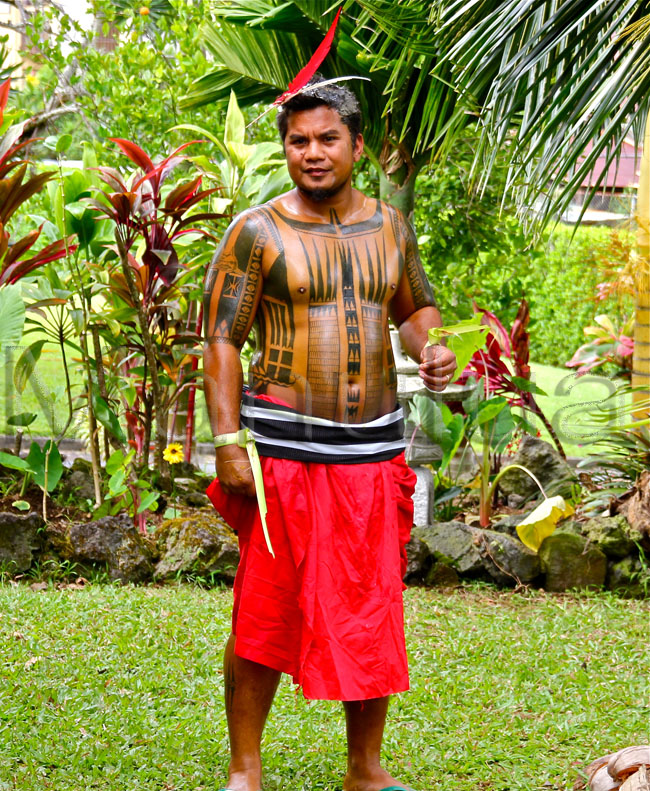 |
| Jermy Uowolo adorning the traditional Maak Tattoo from his island of Fais, Yap. |
Finely tattooed all over,
Dark and clear as black paint.
Over it he puts a loincloth
Painted flame-color with turmeric."
~ Composed in the early 1900s by a mother on Ifalik for her newly tattooed son
I was privileged to tattoo a young man from Fais, Yap. He is first to revive this tradition for his island since the last elder who wore one passed in the 1970s. Tattooing on Fais, and Yap at large fell into disuse during the 1940s - 1950s as traditional tattooist aged and passed away.
Yap is comprised of 4 main islands and 14 outlying atolls - Fais being one of the atolls. At one time, all young men and women across the islands of Yap were tattooed by their teen years. The tattooing followed strict protocols on most of the islands, and was performed by tattoo artists (known as Taupotu on Ifaluk). Women were often tattooed by their husbands as their tattooing also extended through their genitals.
 |
| Uwethog, born c. 1902, lighting up his local-grown tobacco rolled in banana leaf (photo courtesy of Don Rubinstein) |
Different islands had various names for the traditional tattoo such as Yol and Maak. Different areas of the body also had separate names. There were different classes of tattoos that signified rank and birthright. The tattooing of the men most often covered the torso and back, extending down the shoulder to the elbow, and the waist to the upper thighs. The womenʻs tattooing balanced the mens tattoos in that the lower extremities were inked as well as the pubic area. The completion of a Maak on Fais was a community event with week long celebrations that culminated with the individual walking from one side of the island to the other. Their was dancing and feasting as well as ritual cleansing. The tattooed body was considered the epitome of beauty and adulthood in Yap culture.
I met Jermy and the Yap community here in Hilo through good friend, Tricia Allen. She had referred Jermy and a tattooist from Ifalik, Ike Mangi so that I can help them with reviving their tradition. Upon meeting with Jermy and Ike, I immediately saw the same drive and passion that I had for Tongan tattooing. I asked if they would agree to doing some of the work with traditional tools and allow Ike to continue some of the tattooing with machine, to which they both agreed.
 |
| Jermy, myself, and Suʻa Suluʻape ʻAisea |
 Theirs a common thread that binds all of us in the Pacific. This thread unravels to produce the multiplicity of Oceanic cultures, but is still attached to the common root which holds our kinship. Having known nothing about the Yap culture or where Fais was, I was surprised to learn the unquestionable distant link between Tonga and Fais. Tonga was brought out of the depths of the ocean by Maui Kisikisi (also known as Maui Tikitiki). Fais was also brought out of the depths of the ocean by Motiktik. The use of Tumeric and oils as a medicinal aid in healing, cleansing, and protection. Yap traditional stick dance mirrors a traditional Tongan stick dance called the Soke (click on the links below).
Yap Stick Dance Tongan Soke
Many other similarities with foods, forms of respect, social hierarchy, and customs were undoubtedly related. In learning our own revived traditions, Iʻve gained a deeper respect for all traditional cultures striving to maintain their identity in the evolving global culture of the modernization. Thank you to the Uowolo family for allowing me to be part of your rich heritage and for welcoming me into your community. Thank you also to Suʻa and my Tongan brothers and sisters who supported this historical moment.
 |
| Jermy from Fais and Ike from Ifalik |
Sa gachigchig mo Fakaʻapaʻapa atu.
Check out the Soul Signature site for more pictures.

 2011 was a year filled with many new and exciting changes. Aisea was invited to Tonga to present tatatau in the kingdom for the first time in over a 150 years. We also held tool making workshops in Hilo, Hawaiʻi, and crafted some traditional implements for myself and Lopeti.

 not only through tattooing, but migrational voyages, deities, and cultural practices. We also talked a lot about how the introduction of borders and artificial classifications (i.e., Polynesian, Micronesia, etc.) have prevented islanders from continuing long standing relationship with each other. These classifications as well as territorial affiliations with Western countries have created a disconnect in sea voyaging traditions of the past. Maui, the great demigod of much of Polynesia is also found throughout Micronesia, as well as the use of turmeric and oil for sanctifying and protecting the body.


 Another weekend workshop will be planned, but timing is probably the most difficult thing to coordinate. Suʻa has his business and travels, which limits his travel time for teaching. His goal however is to spread the knowledge of traditional tattooing to those willing to learn. Respect for the cultures that carry on these traditions is vital to learning; and understanding the histories which have held island people close to their past is fundamental to beginning the journey.
